
What is RFID (Radio-Frequency Identification) Technology?
The key to an RFID strategy is to align your use of the technology with your company's goals, e.g., reduce production costs, better customer relationships, optimising operations, and more. RFID technology can help you reach your goals.
Making manufacturing more efficient and productive is a shared goal throughout all industries, not to mention electronics. RFID technology has been designed for this purpose. Radio frequency identification can be used to track products through the product lifecycle, data collection to analyze logistics, and production flow to enhance the manufacturing process.
In this article, we discuss what makes up an RFID system, the advantages and disadvantages of the technology, its usage, and the overall market outlook.
Chapter 1
What is RFID (Radio Frequency Identification) Technology?
Radio Frequency Identification or RFID is a specific type of radio technology that uses radio waves to identify tags attached to an object and thus identify the object. The tag contains a transceiver chip which is triggered by the electromagnetic wave from the RFID reader and transmits an identification number back to the reader. The identification number is then used for the inventory of the objects with tags. Tags can be passive or active. Passive tags are only powered by the incident electromagnetic wave from the reader and thus have a shorter operating range. Active tags are powered by a battery and can have greater range, up to hundreds of meters.
With the use of wireless technology, RFID tags do not need a direct line-of-sight to the RFID reader, which brings some significant advantages compared to the barcode scanners widely used in the industry today.
The RFID tag can be embedded or hidden in the object, and several tags can be identified at the same time by a single reader.
A barcode scanner has to ‘see’ a barcode to gather data.
RFID is used in many applications and industries, including pharma, retail, agriculture and medical care, as well as tracking vehicles, pets, and livestock. For example, an object with an embedded RFID tag that is moving through a production line or a warehouse equipped with RFID readers, can be scanned at different production stations and thus its progress can be automatically tracked.
The technology has continued to improve over the years, and the cost of implementing and using an RFID system has continued to decrease, making RFID a cost-effective and efficient alternative to conventional optical scanning. Standard specifications have been developed for RFID technology, addressing security and privacy concerns. Such standards use on-chip cryptography methods for untraceability and tag and reader authentication using digital signature data.
RFID Technology: How Does it Work?

What are the Main Components of RFID Technology?
Tags
RFID tags are what stores and transmits the data that needs to be deciphered. The tags can be attached to assets to send data to the antenna. The microchip embedded in the tag is what stores the tag's ID and programmable data related to the asset. This stored data is then transferred to the reader through antennas.
Antennas
Antennas are necessary elements in an RFID system because they transmit the RFID tag’s data to the reader. Without some type of RFID antenna, whether integrated or standalone, the RFID reader cannot correctly send and receive signals to RFID tags.
Readers
RFID readers are connected to the antenna and receive data from the RFID tag. The reader is what receives and converts the radio waves into digital data on a computer database.
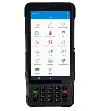
There are two types of readers. There are Fixed Readers and Mobile Readers. Fixed readers are typically mounted to walls or other objects and stay in one location to read data stored in a tag. Mobile readers can be installed or carried anywhere it is needed.
Computer Database
The RFID system requires a computer database to process data stored in tags. This software can program tags, manage devices and data, remote monitoring and hardware configuration.